Architecture and Cultural Heritage in Bologna, Modena and Parma
The cities of Bologna, Modena, and Parma, located in one of Italy’s most culturally sophisticated regions — Emilia-Romagna — represent an extraordinary concentration of art, architectural heritage, religious influence, and civic identity. Exploring these cities reveals how medieval, Renaissance, and Baroque aesthetics evolved while remaining deeply connected to everyday life and community traditions.
This article introduces the architectural landmarks that shaped their identity and explains how history and contemporary life continue to coexist harmoniously in their urban spaces.
Bologna

Bologna’s architectural identity is defined not only by its medieval towers, but also by its remarkable network of porticoes — almost 40 km of sheltered arcades, now recognised as a UNESCO-listed urban system. Historically, porticoes allowed private homes to extend over public space, symbolising the city’s long tradition of shared civic life.
Today, these porticoes function as living corridors used for markets, student life, artisan workshops, and café culture. They are not decorative relics, but practical spaces that shape how the city is experienced on foot.
The Two Towers (Asinelli and Garisenda) remain Bologna’s most iconic medieval monument. Built by noble families competing for prestige, these towers once numbered over one hundred across the city. Torre degli Asinelli, still open to visitors, rewards climbers with a unique perspective of Bologna’s rooftops, churches, piazzas, and terracotta urban fabric.
Piazza Maggiore illustrates Bologna’s ability to merge religious power and civic governance. The Basilica of San Petronio, unfinished yet monumental, remains one of Europe’s most ambitious medieval churches. Facing it, Palazzo d’Accursio — today the city hall and civic museum — continues to function as a living administrative centre while preserving Renaissance interiors and historical archives.
For architectural travellers, Bologna is not simply admired from afar — it is walked, heard beneath echoing porticoes, and experienced through the daily rhythms of markets, universities, and food culture. You can explore more highlights in our guide to things to do in Bologna.
Modena
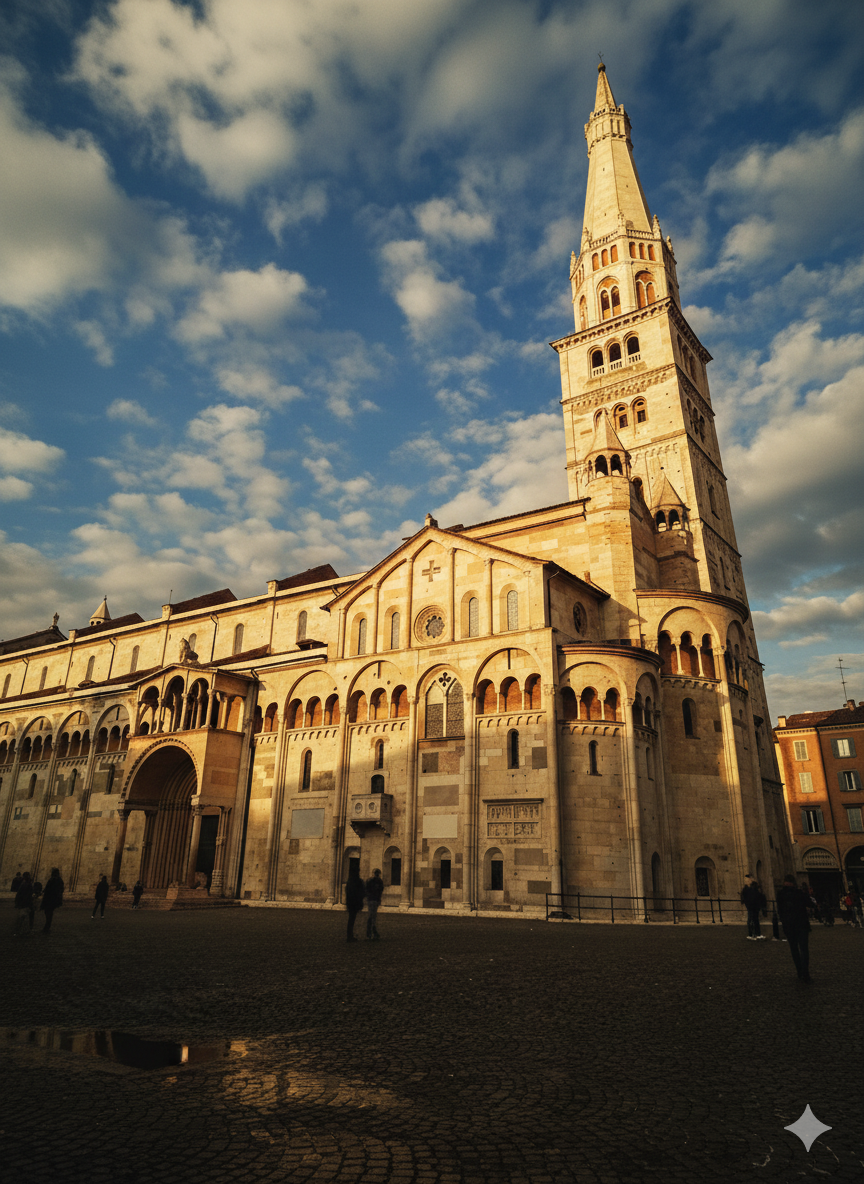
Modena’s UNESCO-listed ensemble — Cathedral, Ghirlandina Tower, and Piazza Grande — forms one of Europe’s most complete medieval architectural complexes. The Cathedral, partly designed by the sculptor Wiligelmo, is a masterpiece of Romanesque narrative sculpture, with marble reliefs depicting biblical cycles, animals, moral allegories, and symbolic imagery.
Rising beside it, the Ghirlandina Tower historically symbolised municipal independence and civic authority. Its vertical form balances the wide horizontal space of Piazza Grande and once served as a navigational reference for merchants and pilgrims traveling between Lombardy, Tuscany, and the Po Valley.
Looking for an authentic food experience?
Join our Foodie's Delight Tour – Parmigiano Reggiano, balsamic vinegar & cured meats in one unforgettable day.
Piazza Grande itself remains Modena’s civic heart. Beneath the stone pavement lie medieval storage spaces once used for grain reserves and public trade. Today, the square continues to host major religious processions and civic celebrations, maintaining uninterrupted traditions.
A short walk away, the Ducal Palace marks Modena’s transformation into a ducal capital under the House of Este. Its monumental baroque façade, courtyards, and ceremonial interiors now house Italy’s Military Academy, preserving the building’s institutional role through daily activity.
Modena’s architecture remains fully integrated into everyday rhythms — markets, worship, ceremonies, and civic life coexist naturally. Discover more landmarks and experiences in our guide to things to do in Modena.
Parma

Parma expresses refinement and artistic elegance through architecture. Its cathedral preserves one of Italy’s most celebrated Renaissance illusions — the dome fresco by Antonio da Correggio, where figures spiral upward into a luminous celestial vortex, anticipating later Baroque movement.
The adjacent Baptistery, built in pink Verona marble, illustrates the transition from Romanesque to Gothic architecture. Its interior sculptural cycles depict months of the year, professions, religious symbolism, and medieval cosmology — a rare visual record of medieval social order.
Nearby stands the Teatro Farnese, commissioned in 1618 for court celebrations. Constructed almost entirely of wood and stucco, it represents an early model of modern theatrical architecture, preserving original stage mechanics, acoustic design, and scenographic structure.
Parma’s architectural character blends artistic sophistication with human scale — elegant rather than imposing. This balance extends into music, gastronomy, and daily urban life. Explore more in our guide to things to do in Parma.
Conclusion
Bologna, Modena, and Parma form a corridor of cultural continuity where architecture has shaped civic identity for centuries. Their monuments remain actively used for worship, government, education, markets, performances, and celebrations. Visiting these cities means entering spaces where architectural memory continues to function as everyday social reality.
Discover more from Emilia Delizia
Subscribe to get the latest posts sent to your email.