
A working Parmigiano Reggiano dairy starts before dawn. By 6am the milk from the previous evening’s milking has been sitting overnight in wide shallow vats, the cream rising to the surface. The casaro skims most of it off — this is what makes Parmigiano a semi-skimmed cheese — and then combines the skimmed evening milk with fresh whole milk from the morning collection. The ratio and the handling of the milk from this point forward are governed by the DOP production specification, which has not changed in any meaningful way for centuries.
The Copper Vat
The milk is transferred into the caldaia — the traditional bell-shaped copper vat that gives Parmigiano Reggiano its characteristic production setting. Copper is used because it distributes heat evenly and has natural antimicrobial properties. Each vat holds around 1,100 litres of milk, enough to produce exactly two wheels. The dairy will run several vats simultaneously, all starting at the same time.
Two things are added to the milk: natural whey starter (siero innesto), saved from the previous day’s production and rich in the lactic acid bacteria that drive fermentation; and calf rennet, which coagulates the proteins. Within ten to fifteen minutes the milk sets into a soft curd.
Breaking the Curd
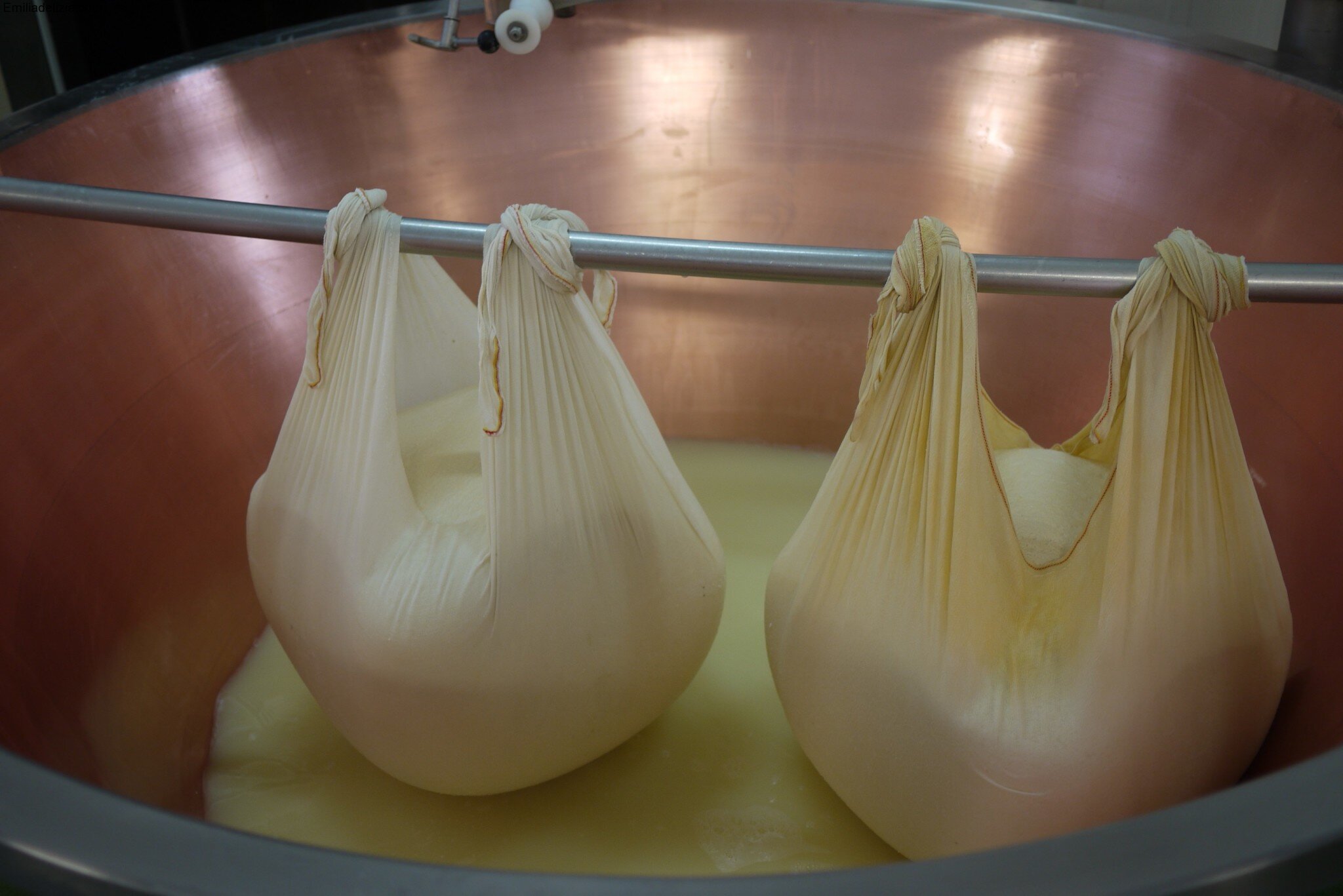
The casaro uses the spino — a large whisk-like tool — to break the curd into granules roughly the size of rice grains. The finer the break, the more whey the curd expels, and the firmer and drier the resulting cheese will be. Parmigiano Reggiano requires a very fine break; this is one of the technical steps that distinguishes it from softer cheeses where the curd is left in larger pieces.
The mixture is then slowly heated to around 55°C while the casaro stirs continuously. The heat causes the granules to contract further, expelling more moisture. When the curd has settled to the bottom of the vat — a process that takes around an hour in total — the casaro collects it in a cloth, divides it into two equal masses, and lifts each one out of the whey. Each mass is placed in a mould and left to drain and firm up for the rest of the day.
Moulding and Marking
The fresh wheels are pressed into their final shape in plastic moulds lined with a band carrying the Consortium’s identification markings. These markings are pressed into the rind while the cheese is still soft: the pin-dot pattern spelling out “PARMIGIANO REGGIANO” in repeating sequence around the circumference, the producer’s number, the month and year of production, and the DOP logo. This information becomes permanently legible on the finished rind and cannot be added later — it is the primary proof of authenticity.
After two or three days in the mould, the wheel has firmed enough to hold its shape. It is a pale, soft, slightly elastic cheese at this stage — nothing like the finished product. The transformation happens in the next two phases: brining and ageing.
Brining
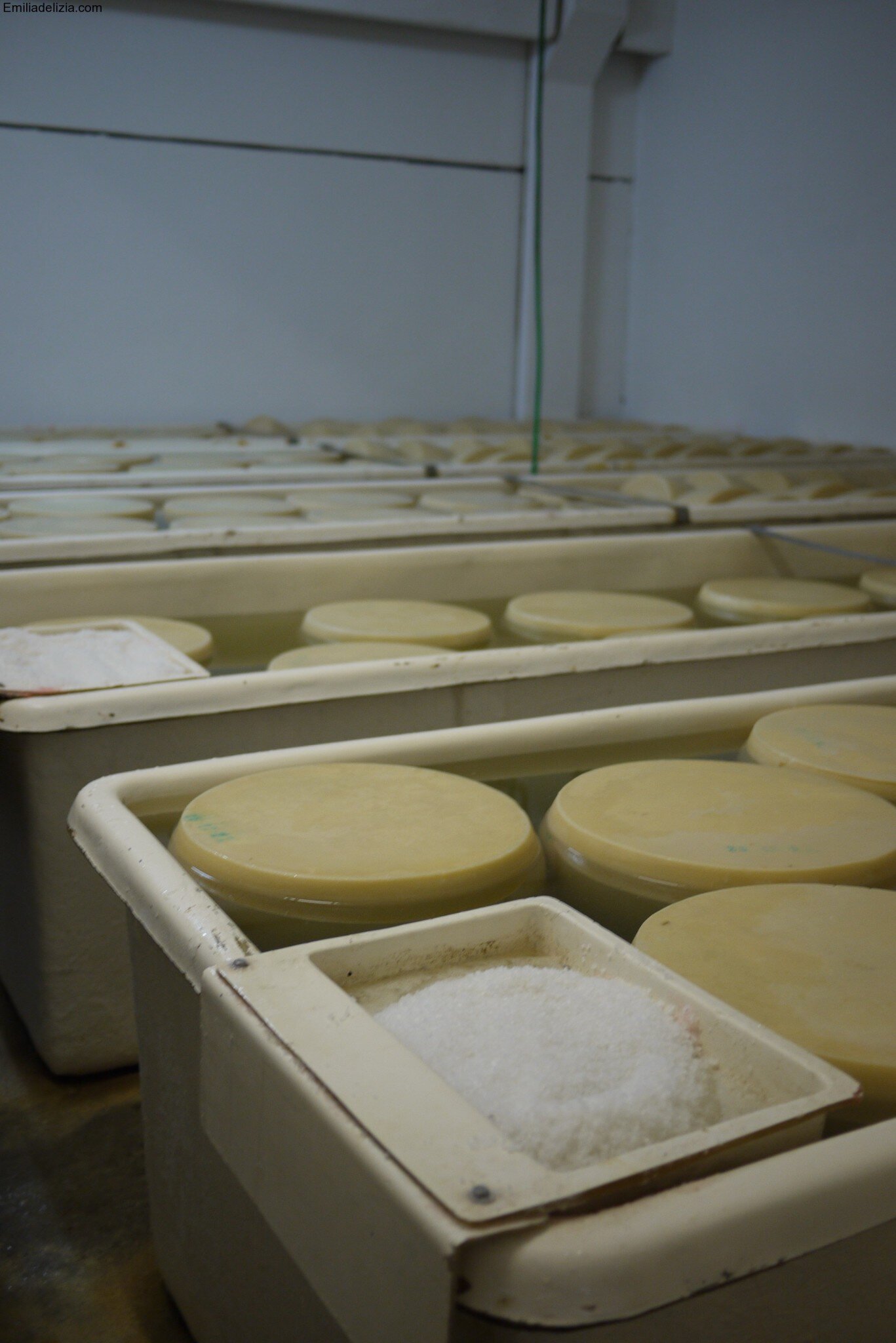
The wheels are submerged in tanks of saturated salt brine for 20 to 25 days, floating with roughly a third of the wheel above the surface (they are turned regularly to ensure even salting). Salt does not penetrate to the centre of the wheel during brining — it enters the rind and moves inward slowly during ageing. The final salt content of a mature Parmigiano Reggiano is around 1.5%, all of it absorbed passively through the rind rather than added during production.
Ageing
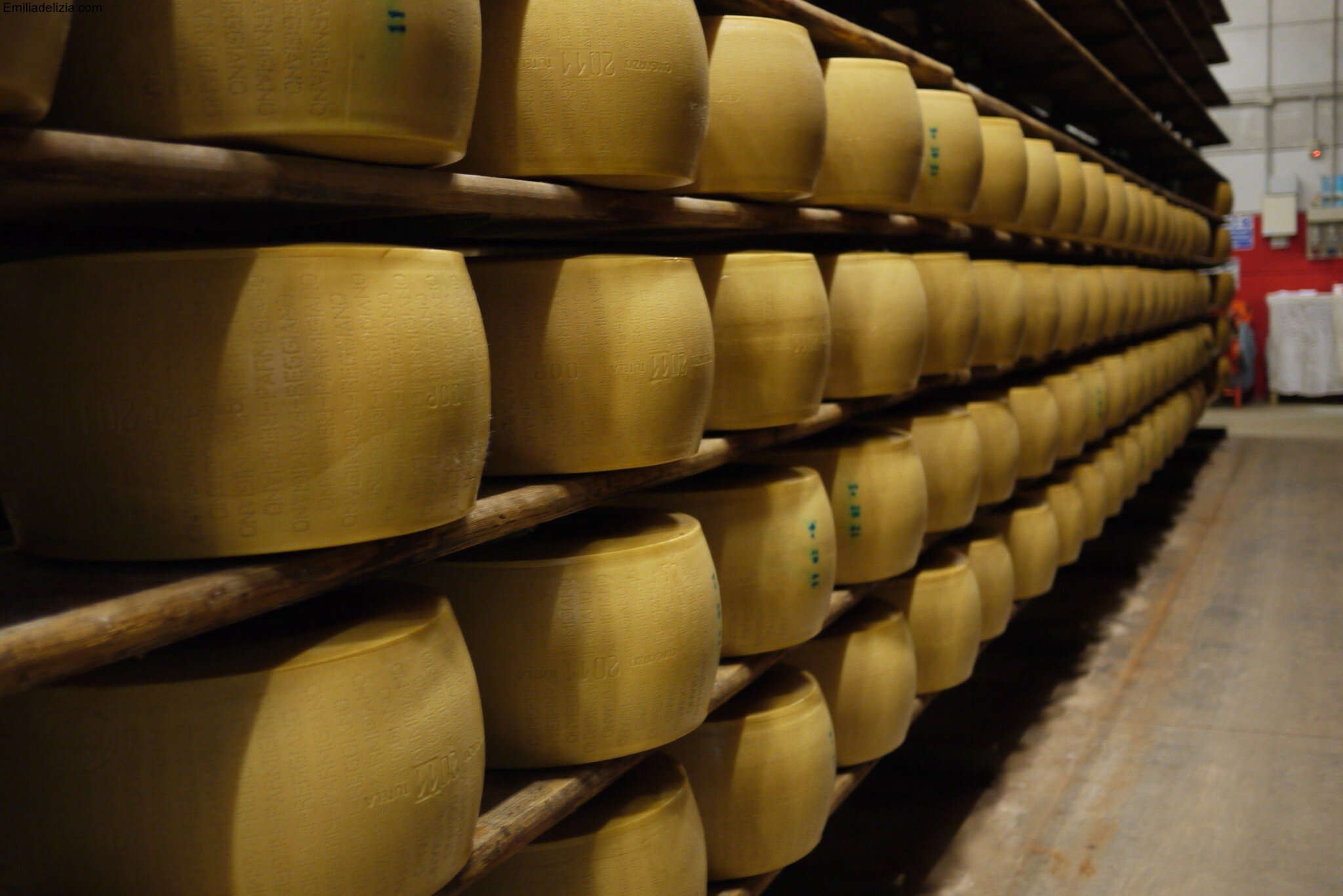
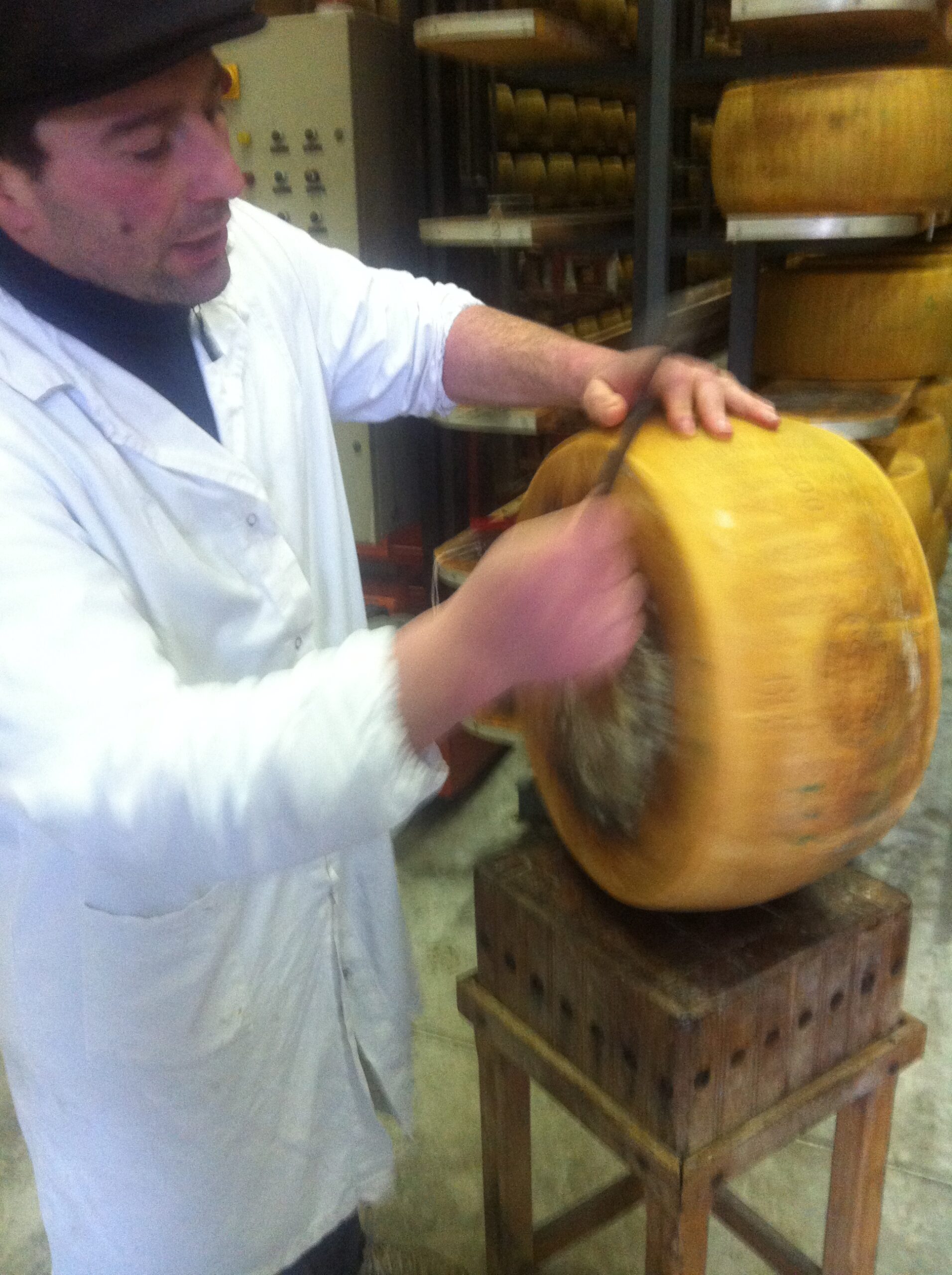
After brining, the wheels move to the ageing room and onto wooden shelves. They will stay there for at least 12 months; most serious production continues to 24 months, and a significant portion goes to 36 months or beyond. During this period each wheel is turned and brushed every few days to prevent mould forming on the rind and to ensure even moisture loss. The wheels lose roughly 20% of their weight as moisture evaporates — this concentration of solids is part of what creates the intensity of flavour in the finished cheese.
At 12 months, a Consortium inspector visits every dairy and tests each wheel with a hammer, listening for the sound of the paste inside. A hollow sound indicates internal cracking or irregular texture; those wheels are rejected and their rinds are stripped, removing the identification markings so they cannot be sold as Parmigiano Reggiano. Wheels that pass are fire-branded with the Consortium’s oval mark. This inspection is not optional and cannot be bypassed.
What Each Age Produces
- 12 months (fresco) — pale, mild, slightly elastic. The minimum permitted age. Uncommon commercially; occasionally sold at the dairy itself.
- 24 months — the standard. Granular texture, clean flavour with a sweet-savoury balance. Suitable for grating, cooking, and eating in chunks.
- 36 months — darker paste, pronounced umami, visible amino acid crystals. More assertive flavour. Better for eating raw or finishing dishes than for cooking.
- 40 months and above — intense, complex, almost brittle. Dense crystals throughout. Best eaten alone, shaved, or paired with aged balsamic vinegar.
Watching the production process in person — from the morning milk delivery through curd-breaking, moulding and the ageing rooms — takes about two hours and changes how you understand what you are eating. Our Parmigiano Reggiano dairy tour from Bologna visits a working caseificio on a production morning and includes a tasting of multiple ages at the dairy. For a broader food production circuit that also covers Parma ham and balsamic vinegar, see our pasta making class in Modena.
Frequently Asked Questions
How long does it take to make Parmigiano Reggiano?
The active production — from milk to freshly moulded wheel — takes one morning, roughly 5–6 hours. The ageing then takes a minimum of 12 months, during which the wheels are turned and brushed regularly. Most commercial Parmigiano Reggiano is aged 24 months; premium production runs to 36 months or beyond. The total time from milk to finished 36-month cheese is just over three years.
How many litres of milk does one wheel of Parmigiano Reggiano require?
Approximately 550 litres of milk go into each wheel. A standard copper production vat holds around 1,100 litres and produces two wheels simultaneously. A finished wheel weighs between 38 and 40 kilograms.
What is the spino used for in Parmigiano Reggiano production?
The spino is a large whisk-like tool used to break the coagulated curd into very fine granules — roughly the size of rice grains. The fineness of the break determines how much whey the curd expels: the finer the granules, the drier and firmer the resulting cheese. Breaking the curd to this degree is one of the technical steps specific to Parmigiano Reggiano and other hard grana-style cheeses.
Why are the markings on a Parmigiano Reggiano wheel important?
The pin-dotted markings pressed into the rind during production — the name, producer number, month and year, and DOP logo — are the primary proof of authenticity. They are applied while the cheese is still soft and cannot be added later. Wheels that fail the 12-month inspection have their rinds stripped to remove all markings, so they cannot be sold as Parmigiano Reggiano.
Can you visit a Parmigiano Reggiano dairy?
Yes — many dairies in the provinces of Parma, Reggio Emilia, and Modena accept visitors on production mornings, typically starting around 8am. The full production cycle from curd-breaking to moulding takes about two hours to observe. Our Parmigiano Reggiano dairy tour from Bologna organises guided visits to a working caseificio and includes a tasting of cheeses at different ages.
Discover more from Emilia Delizia
Subscribe to get the latest posts sent to your email.