Passatelli in brodo is one of the dishes that visitors to Bologna most consistently overlook. It does not appear on tourist menus. It is not photogenic in the way that a plate of tagliatelle al ragù is photogenic. It is a winter soup — short cylinders of a paste made from breadcrumbs, Parmigiano Reggiano, eggs, nutmeg, and lemon zest, pressed through a special iron disc and cooked directly in beef broth. It looks modest. It tastes extraordinary. And it tells you more about how Emilia-Romagna actually cooks than almost anything else on a Bolognese menu.
What Passatelli Are
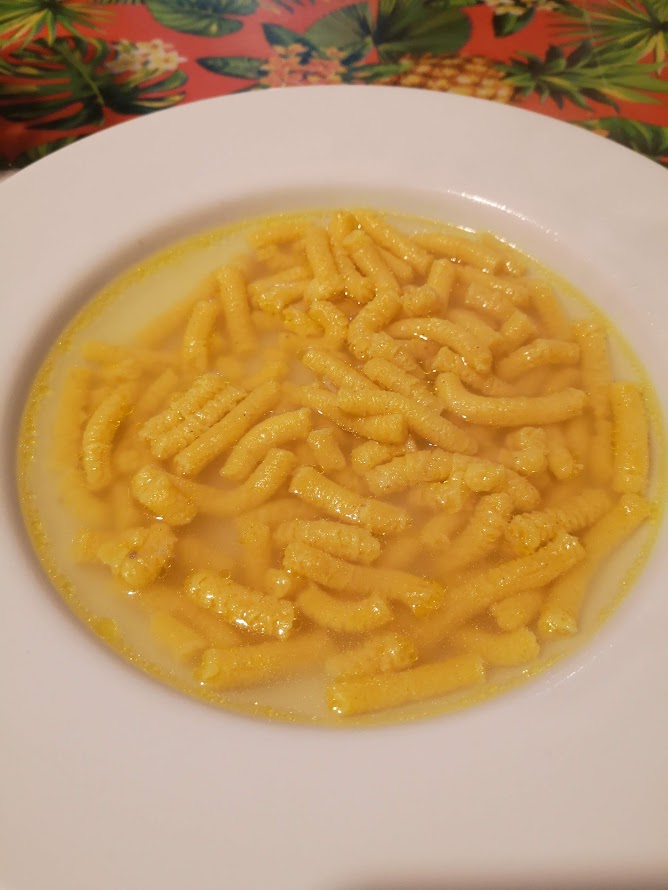
The name comes from the verb passare — to pass through — which describes the making process precisely. A firm dough of grated stale bread, finely grated Parmigiano Reggiano, eggs, nutmeg, and lemon zest is pressed through a special tool called the ferro per passatelli: a slightly domed metal disc around 15cm in diameter, perforated with holes of 4 to 5mm, with two handles for pressing the dough through. The resulting cylinders, each around 4cm long, drop directly into simmering broth, cook for two to three minutes until they rise to the surface, and are served immediately in the same broth.
The ingredient list is deceptively simple. There is no flour — which is what makes passatelli unusual among the pasta dishes of Emilia-Romagna. The structure comes entirely from the breadcrumbs, the cheese, and the egg. The ratio matters enormously. Too much bread and the passatelli become heavy and stodgy; too much cheese and they fall apart in the broth. The right balance produces a cylinder that holds its shape during cooking but yields immediately when eaten — soft, rich, intensely savoury, fragrant with nutmeg and lemon.
The Broth Is Half the Dish
A point that cannot be overstated: passatelli are only as good as the broth they are cooked and served in. The traditional broth is brodo di carne — a long-simmered beef and capon broth made from bones, vegetables, and aromatics, cooked for at least three hours to develop depth and clarity. The broth is not a backdrop. It is a primary ingredient, and the passatelli absorb its flavour during cooking. A thin or under-seasoned broth produces a mediocre dish regardless of how well the passatelli themselves are made.
This is why passatelli in brodo belongs firmly in the category of cucina povera at its most sophisticated — not because the ingredients are cheap (Parmigiano Reggiano is anything but), but because the dish requires nothing beyond time, technique, and a properly made broth. There is nowhere to hide a shortcut.
History: From Peasant Table to Easter Celebration
Passatelli have roots that go back to at least the medieval period, and the dish appears across a wide arc of central Italy — Emilia-Romagna, the Marche, and Umbria — in the territories that once formed the Papal States. The basic logic of the dish is one of resourcefulness: stale bread, aged cheese, and eggs were combined to create something sustaining and delicious from ingredients that were already in the house.
In the past, passatelli were not everyday food. They were made for important occasions — Easter above all, but also births, baptisms, and weddings — because bread and Parmigiano Reggiano were valuable. In wealthier households the ratio leaned heavily towards cheese; in farmhouses it leaned towards bread. The dish thus carried social information as well as flavour: you could tell something about a household’s means from the passatelli it served. Today that social dimension has collapsed — passatelli appear on trattoria menus across the social spectrum — but the dish retains its seasonal and festive associations. It is still a winter dish, still associated with cold weather and long Sunday lunches, still something Bolognese families make at home more than they order in restaurants.
Bologna vs. Romagna: Two Versions of the Same Dish
There is a running debate within Emilia-Romagna about which version of passatelli is definitive. The Bolognese version uses the ingredients described above — breadcrumbs, Parmigiano, egg, nutmeg, lemon — and serves the passatelli exclusively in broth. The Romagnola version, from the coastal and hill towns east of Bologna, sometimes adds bone marrow to the dough for additional richness, and is more likely to be served asciutti — dry, without broth, dressed with a sauce.
Looking for an authentic food experience?
Join our
Foodie’s Delight Tour – Parmigiano Reggiano, balsamic vinegar & cured meats in one unforgettable day.
The dry version has become more common in recent years as restaurants look for ways to serve passatelli year-round rather than only in winter. Asciutti passatelli appear with mushroom sauces, with truffle, with seafood on the Adriatic coast, and with various vegetable-based dressings. These are good dishes in their own right, but they are different from the original. The in brodo version — hot broth, simple bowl, nothing else — is the one that most clearly expresses what passatelli are for.
The Ferro per Passatelli: A Kitchen Tool Worth Knowing
The pressing tool — the ferro per passatelli — is specific to this dish and not easily substituted. A potato ricer produces a similar result but gives a rougher, less even cylinder. A meat grinder with a large-hole disc is another common workaround. The original iron disc, found in kitchen shops and markets throughout Emilia-Romagna, is a useful souvenir for anyone serious about recreating the dish at home — compact, inexpensive, and impossible to find outside the region. The food markets of Bologna are the natural place to look.
Where to Eat Passatelli in Bologna
Passatelli in brodo appears on the menus of Bologna’s traditional trattorias from October through to March, and occasionally into April. It is a dish that requires planning to eat well — the broth needs hours, the dough needs to rest — and most serious trattorias make it properly or do not make it at all.
Look for it at Osteria Broccaindosso, one of the city’s most dependable traditional rooms, and at the older trattorias in the university quarter and the Bolognina district where the kitchen leans towards the Bolognese classics rather than towards tourist-facing menus. If a restaurant offers passatelli in July, it is almost certainly serving the dry version — which is fine, but not what you came for. If you visit between November and February, order the in brodo without hesitation.
How to Make Passatelli at Home
The recipe is one of the more approachable in the Bolognese repertoire, assuming you have a good broth and the pressing tool. The dough takes ten minutes to assemble and needs an hour to rest in the refrigerator before pressing. The proportions below serve four as a starter:
- 300g fine dry breadcrumbs (from stale white bread, not commercial breadcrumbs)
- 200g Parmigiano Reggiano, finely grated
- 2 whole eggs
- Nutmeg, freshly grated — generous pinch
- Zest of half a lemon
- Salt to taste
- 1.5 litres good beef and capon broth
Combine the dry ingredients, add the eggs, and work to a firm, uniform dough. If it is too dry to hold together, add a small amount of broth — not water. Wrap and rest in the refrigerator for one hour. Bring the broth to a gentle simmer — not a rolling boil, which would break the passatelli apart. Press the dough through the ferro directly into the broth, cutting each cylinder at around 4cm with a sharp knife or the edge of the press. Cook for two to three minutes until the passatelli rise and firm up slightly. Serve immediately in deep bowls with the broth, and a little extra Parmigiano at the table.
For those who want to learn this and the other pasta dishes of the Bolognese tradition properly, pasta making classes in Bologna cover the full range of the local repertoire — from fresh tagliatelle and tortellini to dishes like passatelli that rarely appear in Italian cooking schools outside the region itself.
Why It Matters
Passatelli in brodo is not the dish that made Bologna famous internationally. Tagliatelle al ragù has that role, and it deserves it. But passatelli is the dish that Bolognese families actually cook on cold Sunday mornings, the dish that appears at family tables for Christmas and Easter, the dish that has been made the same way for centuries from ingredients that most households keep without planning. Eating it in Bologna, in a room of local families doing exactly the same thing, is one of the more direct encounters with the city’s food culture available to a visitor. It costs almost nothing. It requires no reservation. It only requires being there in the right season and knowing what to order.
Discover more from Emilia Delizia
Subscribe to get the latest posts sent to your email.