Introduction
The cities of Bologna, Modena, and Parma, located in one of Italy’s most sophisticated regions—Emilia-Romagna—represent an extraordinary concentration of art, architectural heritage, religious relevance, and civic culture. Exploring these cities reveals how Italian medieval, Renaissance, and Baroque aesthetics evolved while remaining connected to everyday life and community identity. This article introduces the architectural landmarks that shaped their identity and explains how past and present coexist harmoniously in their urban spaces.
Bologna

Bologna’s architectural DNA is defined not only by its medieval towers, but by its incredible network of porticoes—almost 40km of sheltered arcades—now a UNESCO-listed urban system. Historically, porticoes allowed private household extensions over public space, symbolising Bologna’s commitment to shared civic life. Today they remain an unusual architectural feature in Europe: not decorative additions, but living corridors used for markets, student life, artisan workshops, and café culture.
The Two Towers (Asinelli and Garisenda) are the most iconic monument of medieval Bologna. Built by noble families competing for prestige, these towers once numbered over one hundred. Torre degli Asinelli, still accessible to visitors, rewards climbers with a unique perception of Bologna’s urban structure—its grid, rooftops, churches, and piazzas merging into shades of terracotta and amber.
Piazza Maggiore, the monumental civic square, demonstrates Bologna’s ability to merge religious significance and political governance. The Basilica of San Petronio, although unfinished on the façade, is one of Europe’s most ambitious medieval church projects. Inside, architectural scale meets fine frescoes and liturgical complexity. Facing it, Palazzo d’Accursio—now Bologna’s city hall and civic museum—remains a living administrative centre while showcasing Renaissance interior décor, vaulted halls, and municipal archives.
For architectural travellers, Bologna is not simply admired from afar—it is walked, experienced, heard under echoing porticoes, and tasted through its culinary institutions that originated inside these medieval environments. Architecture and daily life remain inseparable.
Modena
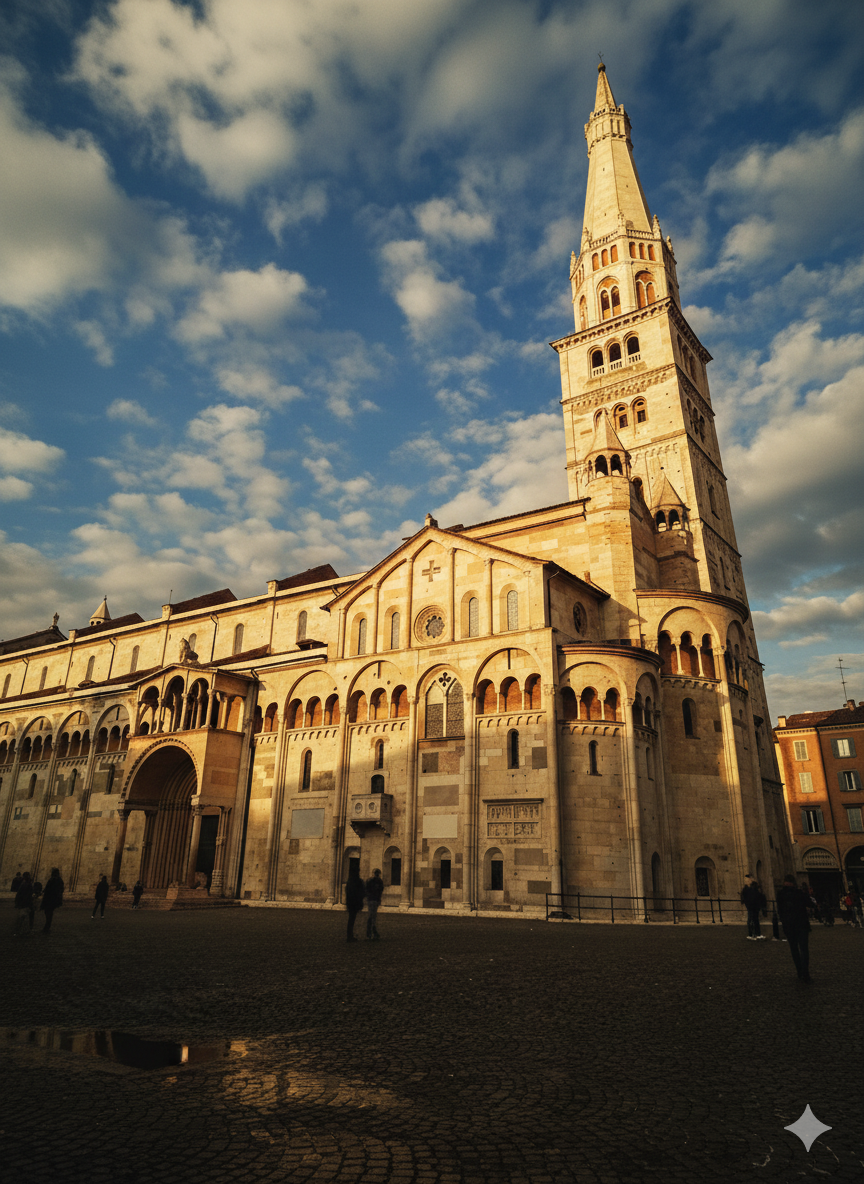
Modena’s UNESCO-listed system—Cathedral, Ghirlandina Tower, and Piazza Grande—forms one of Europe’s most celebrated medieval complexes. The Cathedral, designed partly by the sculptor Wiligelmo, is a masterpiece of Romanesque narrative architecture. His marble reliefs still clearly depict biblical cycles, animals, religious symbols, and moral scenes—exceptionally rare for 12th-century Italy because of their sculptural depth and storytelling emphasis.
Next to the cathedral rises the Ghirlandina, Modena’s civic tower. It served historically as symbol of municipal independence and authority, especially in medieval conflicts with neighbouring powers. Its verticality visually balances the horizontal complexity of Piazza Grande, and its pointed spire became a navigational landmark for merchants and pilgrims traveling toward Lombardy, Tuscany, or the Po region.
Piazza Grande itself still functions as the civic heart of Modena. The pavement stone layout, porticoed municipal buildings, and medieval storage rooms below ground represent centuries of public trade and grain custody. Today, it remains a ceremonial place where major city events—including religious processions and civic celebrations—continue uninterrupted traditions.
A few streets away, the Ducal Palace marks Modena’s transformation into a ducal capital under House of Este. Its baroque façade, monumental staircase, courtyards, and frescoed chambers once served royal life. Today, it houses Italy’s prestigious Military Academy, preserving its ceremonial function through military parades, uniformed ceremonies, and institutional gatherings.
Modena stands apart in how its architecture remains visibly integrated into everyday rhythms—from market activity around Piazza Grande to cathedral rites and civic events. Nothing is archaeological or frozen—the spaces remain lived.
Parma

Parma communicates refinement and cultural elegance through architecture. Its cathedral preserves one of Italy’s greatest Renaissance illusions—the dome fresco by Antonio da Correggio. Rather than painting flatly, he opened the dome into a spiralling procession of angels ascending into a celestial vortex. It is considered one of the earliest visual antecedents of Baroque optical movement.
The adjacent Baptistery, octagonal and crafted in pink Verona marble, demonstrates how Italy transitioned from Romanesque to Gothic. Internally, sculptural cycles represent months of the year, trades, religious symbolism, and medieval cosmology. This is rare example of complete medieval social taxonomy carved in stone.
A short walk away lies Teatro Farnese, originally commissioned for court entertainment in 1618. Built entirely in wood and stucco, it stands as a precursor of modern theatrical architecture. The proscenium arch stage, acoustic balconies, seating tiers, and dramatic scenographic machinery reveal Parma’s aristocratic artistic investment. Few theatres globally preserved from that era maintain their original technical layout.
Parma’s architectural language blends artistic sophistication with civic scale—never monumental and intimidating, but always refined and human-centred. This balance carries into music (Verdi’s heritage), gastronomy, and the general urban atmosphere.
Conclusion
Bologna, Modena, and Parma are not simply northern Italian cities—they constitute a corridor of cultural heritage and artistic continuity, where architectural identity has shaped civic pride. Their urban spaces allow visitors to move from Romanesque to Gothic to Baroque in only a few kilometres. Most importantly, their monuments remain alive—used daily for worship, government, academic life, markets, performances, and celebrations. Visiting them means entering spaces where architectural memory still functions as social reality.
Discover more from Emilia Delizia
Subscribe to get the latest posts sent to your email.